Resource hub for UK exhibitors
The best exhibition stand designs are the ones that pull people in from three aisles away and still make sense up close.
Height, light, a clear entry point and one honest idea. This guide breaks down what good design actually looks like on a UK show floor, what it costs and how early you need to start.
What the best exhibition stand designs have in common
Strip away the trends and the stands that work share the same handful of traits.
- They read from distance. A brand name and a single benefit, held high, legible from the far end of the aisle.
- They have an obvious way in. No rope line of furniture across the front. An open corner or a wide threshold invites people to step on.
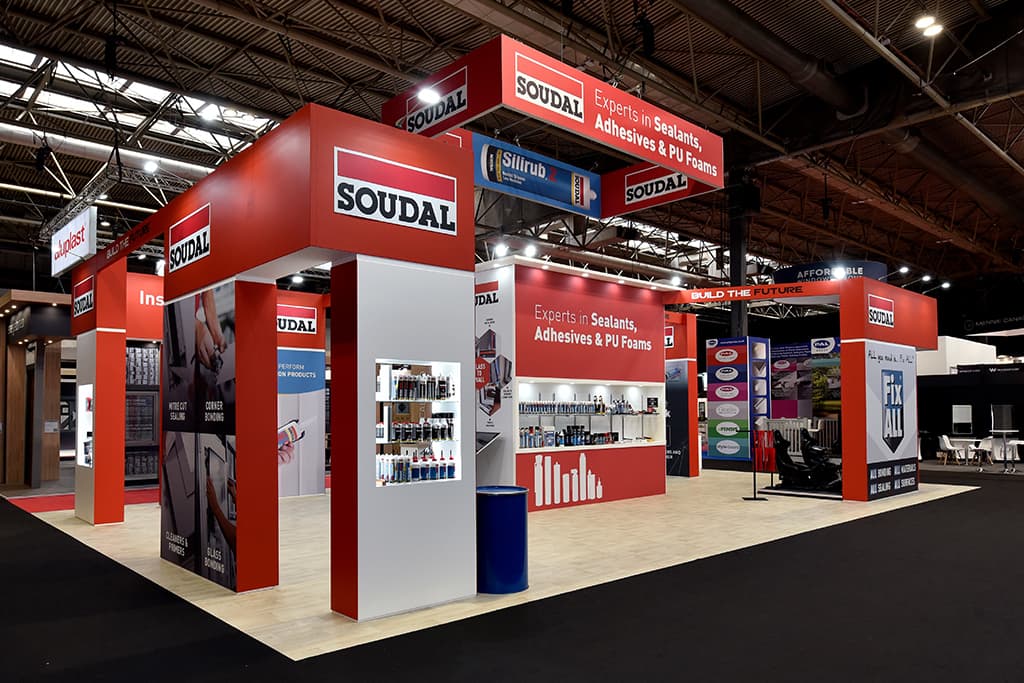
- They use height and shape. Bulkheads, towers, suspended banners and curved forms give a stand presence that a flat 2.5m wall never gets.
- They control light. Light boxes, washed walls and focused spots on the product, rather than relying on the hall's overheads.
- They put the product where the hands are. Demo benches at working height beat products locked behind glass.
- They leave room to talk. Somewhere quiet to sit changes a chat into a qualified conversation.
- They finish properly. Clean edges, flush joints, hidden fixings and cable runs. Visitors do not name it, but they feel it.
One idea, expressed well, beats five ideas competing for the same 20 square metres.
Modular, hybrid and custom build: three different things
UK exhibitors are sold three categories and they are often blurred. They are not the same.
Modular is off-the-shelf. Pole and panel, pop-ups, aluminium frames with infill panels. Pre-manufactured to standard sizes at a standard height of around 2.5m. It suits exhibitors doing five or more shows a year on a modest budget, and it can be self-built.
Hybrid is a mixture of modular and custom build. Usually system light boxes combined with purpose-built elements. It is much less common now than it once was.
Custom build is designed and made from scratch for one brand and one space. No system limits on height, shape, material or finish.
T2 Display build custom stands only, for spaces from 20 square metres up to 100 square metres. We do not sell modular or hybrid stands as a product line, though system components such as light boxes are used inside a custom build where they are genuinely the right answer.
We explored modular systems many times over the years and invested in the kit. Clients kept asking for the same things: more personalisation, greater height and shape, a more dynamic presence. So custom is what we do.
Parker Knoll
“This experienced and talented team of craftsmen do a first class job, and I would recommend them without hesitation.”
Donna Bellingham, Parker Knoll
Design ideas that hold up on a real show floor
Inspiration boards are full of installations that were never built to a hall's rules. These ideas survive contact with a live NEC or ExCeL floor plan.
- A high-level brand marker. A tower or bulkhead carrying the logo above head height, sited so it is not blocked by neighbours.
- Layered lighting. Backlit fabric for glow, LED strip for edges, spots for product. Three layers read far better than one.
- A storytelling wall. A single long graphic run that takes a visitor from problem to product as they walk it.
- Product front, meeting back. Sell at the aisle, close in the quieter zone behind.
- Real materials. Timber, laminate, painted MDF, metalwork and printed fabric, chosen for texture rather than novelty.
- A reason to pause. A working demo, a sample bench, a screen with something worth watching.
- Storage that disappears. A lockable cupboard built into the structure, so coats and boxes never end up on show.
- Flooring as a boundary. A raised or contrasting floor tells people where your space starts.
Design for the stand you will actually staff. A busy two-person stand needs different geometry to a ten-person one.
What a stand like that costs in the UK
Budget is where most design conversations should start. Here is how a custom build usually splits.
- Design and 3D visuals: free of charge for qualifying enquiries.
- Fabrication and build: typically around half of any contract value. From 4,000 GBP at the small end, 8,000 to 20,000 GBP mid-range, up to 50,000 to 60,000 GBP on large contracts.
- Graphics and print: 3,000 to 8,000 GBP mid-range. Graphics-led builds can run 12,000 to 18,000 GBP.
- Electrics and lighting: 1,200 to 5,000 GBP, up to 6,000 GBP on larger builds.
- Transport and logistics: 600 to 2,000 GBP.
- Installation: 2,000 to 5,000 GBP depending on contract size.
- Breakdown: 1,500 to 4,000 GBP. De-rigging takes nearly as much labour as build-up, so it is never a rounding error.
- Storage: quoted separately.
A typical mid-range custom build totals 16,000 to 44,000 GBP. If a design idea is pushing you past your number, it is usually cheaper to simplify the structure and spend the money on lighting and graphics.
Timings: why the best designs start two months out
Good design needs runway, and so does paperwork.
Design approval and the CDM declaration can take up to six weeks. That is the organiser and venue process, not the build. So a stand builder should ideally be appointed at least two months before the show. Finished artwork is needed four weeks before.
A workable sequence looks like this.
- Brief and space plan agreed.
- Design concept and 3D visuals produced.
- Design signed off and submitted for approval, with the CDM declaration.
- Fabrication in the workshop while artwork is finalised.
- Graphics printed and applied.
- Transport, installation, show days, breakdown, then storage if the stand is being reused.
Leave it late and the design gets cut to fit the calendar. Start early and the design gets to be the best version of itself.
How to judge whether a builder can actually deliver it
Anyone can show you a render. Fewer can hand you the finished thing on a Sunday build-up.
Ask these questions.
- Who makes it? T2 Display have a permanent in-house team of carpenters, electricians and fabricators. In-house trades mean changes get made, not excused.
- How long have they been doing it? Bespoke exhibition stand design and build since 2001.
- Are they accredited? T2 are an ESSA member, the trade body for UK event suppliers.
- Do clients come back? More than 75% of T2's work comes from existing clients. Six consecutive years designing and building Lely's key UK event stand at the NEC. Other clients include Soudal, Pinarello, Dentally, Journeo, Software of Excellence and Horiba Mira, plus the BSA Guns stand in Hall 6 at The Great British Shooting Show.
- Do they know the venue? T2 are based in Tamworth, Staffordshire, about 20 minutes from the NEC Birmingham. We also work regularly at the ICC and Resorts World Arena in Birmingham, Coventry Building Society Arena, ExCeL London, Olympia London, Harrogate and international shows.
- Is it one contract or six? Design, 3D visuals, build, graphics, transport, installation, breakdown and storage under one roof means one point of contact when something moves.
Your questions, answered.
What makes an exhibition stand design stand out at a big hall like the NEC?
How much does a custom exhibition stand cost in the UK?
What is the difference between modular, hybrid and custom stands?
How far in advance should I appoint a stand builder?
What stand sizes does T2 Display work with?
Is modular ever the better choice?
Got a show in the diary? Let's talk about the stand.
Tell us the venue, the space size and roughly what you want to achieve. We will come back with ideas and a clear quote, and design and 3D visuals are free of charge for qualifying enquiries.
Let's work together
Tell us about your show and your stand space. One project lead will work with you from the first sketch to the final dismantle, and we are always happy to sign an NDA.
In-house design & build since 2001 · ESSA member · 75% of clients come back