Exhibition stand guide
Modular suits five or more shows a year on a modest budget. Custom suits one brand, one space and no system limits.
T2 Display have designed and built bespoke stands since 2001, twenty minutes from the NEC. Here is the honest comparison, including when the simpler option is the better buy.
The three UK stand categories, kept separate
British exhibiting has three distinct options. They get muddled constantly, so here is the plain version.
- Modular. Off-the-shelf systems. Pole and panel, pop-ups, aluminium frames with infill panels. Pre-manufactured to standard sizes at a standard height of about 2.5m.
- Hybrid. A mixture of modular and custom build. Usually system light boxes combined with purpose-built elements. Much less common now than it once was.
- Custom build. Designed and made from scratch for one brand and one space. No system limits on height, shape or material.
Hybrid is not another word for modular. It is the middle ground where a system carcass carries bespoke joinery and graphics. Knowing which of the three you are being quoted for is the first step to comparing quotes fairly.
When modular is genuinely the right call
If you are doing five or more shows a year on a modest budget, modular usually wins. The kit is bought once, packed into cases and reused. It can be self-built by your own team, which removes installation labour from the sums. Standard sizes mean you can reconfigure the same components across a 3m x 3m shell scheme one month and a slightly larger space the next.
Modular also suits exhibitors who need certainty over ambition: a tidy, repeatable presence with a clean graphic wrap, set up in a morning.
T2 Display do not sell modular or hybrid stands as a product line. We explored modular systems many times over the years and invested in the kit. Clients consistently came back asking for more personalisation, greater height and shape, and a more dynamic presence. So we build custom only. If modular is right for you, buy it from a modular supplier with a clear conscience.
No Climb Products
“They have never let us down and have always delivered a quality stand that meets our requirements.”
Stephen Beadle, No Climb Products
When custom build earns its money
Custom starts to make sense when the stand has a job to do beyond being present.
- Your space is 20 square metres or larger. T2 build custom stands for spaces from 20 square metres up to 100 square metres.
- You need height. Modular sits at around 2.5m. Custom lets you build tall, so you are visible from the other end of a hall like NEC Hall 6.
- You need shape. Curves, arches, double-deck feeling, product gantries, integrated storage, working demo areas, a meeting room with a door that shuts.
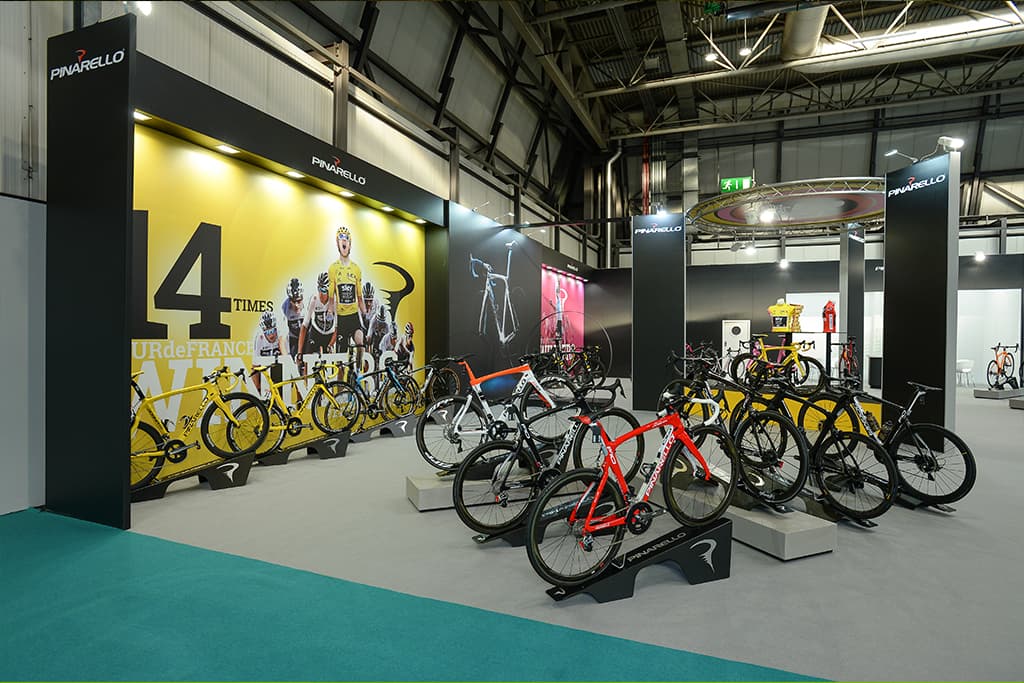
- Your product is awkward. Heavy machinery, bikes, vehicles, anything that needs load-bearing plinths or fixings a system frame will not take.
- The brand has to be unmistakable. One brand, one space, no visible system joints.
System components are not banned from a custom build. We use parts such as light boxes inside a bespoke stand where they are the right answer. The difference is that they serve the design, rather than the design bending to fit them.
The real cost breakdown of a custom stand
Most quotes hide the shape of the spend. Here is how a T2 contract typically splits, so you can sanity-check any quote you receive.
- Design and 3D visuals: free of charge for qualifying enquiries.
- Fabrication and build: typically around half of the contract value. From 4,000 GBP at the small end, 8,000 to 20,000 GBP mid-range, up to 50,000 to 60,000 GBP on large contracts.
- Graphics and print: typically 3,000 to 8,000 GBP mid-range. Graphics-led builds can run 12,000 to 18,000 GBP.
- Electrics and lighting: typically 1,200 to 5,000 GBP, up to 6,000 GBP on larger builds.
- Transport and logistics: typically 600 to 2,000 GBP.
- Installation: typically 2,000 to 5,000 GBP depending on contract size.
- Breakdown: typically 1,500 to 4,000 GBP. De-rigging takes nearly as much labour as build-up, so be suspicious of a quote that treats it as an afterthought. Storage is quoted separately.
A typical mid-range custom build totals 16,000 to 44,000 GBP. Judge it across the life of the stand, not one show. Structures and graphics can be reworked for later events, and we store them between shows.
A simple decision framework
Work through these in order. The answers usually settle it.
- How many shows a year? Five or more on a modest budget points to modular. One to three significant shows points to custom.
- How big is the space? Under 20 square metres, a system or shell scheme graphic package is usually the sensible buy. Twenty square metres and above is custom territory.
- Does 2.5m height work for you? If your neighbours will be taller and you need to be seen, custom.
- What has to happen on the stand? Demonstrations, private meetings, product handling and storage all push towards bespoke joinery.
- Who is building it? If your team will self-build, modular. If you want a permanent in-house team of carpenters, electricians and fabricators handling it, custom.
- What does the brand demand? If a visible system frame would undercut the product, custom.
If steps one to three all point to modular, take the cheaper route. We would rather tell you that than sell you the wrong stand.
Timings: the part that catches exhibitors out
Custom needs lead time that modular does not.
- Design approval and the CDM declaration can take up to six weeks. Organisers and venues will not waive this.
- Appoint a stand builder at least two months before the show. Earlier is better if the space is large or the design is complex.
- Finished artwork is needed four weeks before the show so graphics can be printed, checked and fitted.
Modular can be turned around faster because the structure already exists and only the graphics change. That speed is a real advantage if you have just been offered a late space. If your show is weeks away and the stand is not designed, be realistic about which option the calendar allows.
Why exhibitors keep coming back to T2
T2 Display have been designing and building bespoke exhibition stands since 2001, from Tamworth in Staffordshire, about twenty minutes from the NEC Birmingham. We are ESSA members, and more than 75% of our work comes from existing clients.
Everything happens under one roof: design, 3D visuals, build, graphics, transport, installation, breakdown and storage. The carpenters, electricians and fabricators are permanent in-house staff, not subcontracted for the week.
We have worked with Soudal, Pinarello, Dentally, Journeo, Software of Excellence and Horiba Mira. We designed and built Lely's key UK event stand at the NEC for six consecutive years, and built the BSA Guns stand in Hall 6 at The Great British Shooting Show.
Beyond the NEC, we regularly work at the ICC and Resorts World Arena in Birmingham, Coventry Building Society Arena, ExCeL London, Olympia London, Harrogate, and on international shows.
Your questions, answered.
Is a custom stand always more expensive than modular?
What is the difference between hybrid and modular?
Do T2 Display supply modular stands?
How much does a mid-range custom exhibition stand cost?
How far in advance should I appoint a stand builder?
How tall can a custom stand be compared with modular?
Not sure which way to go? Ask us.
Tell us the show, the space size and roughly what you want to achieve. We will tell you honestly whether a custom build is right, and give you ideas and a clear quote. Design and 3D visuals are free of charge for qualifying enquiries.
Let's work together
Tell us about your show and your stand space. One project lead will work with you from the first sketch to the final dismantle, and we are always happy to sign an NDA.
In-house design & build since 2001 · ESSA member · 75% of clients come back